
 Global
 EU
EU USA
USA PA
PA PAK
PAK MEA
MEAFiber optic technology has advanced exponentially since its debut. The capacity, affordability, and application range of optical networks have all risen due to advancements in materials science, manufacturing, and transmission techniques. These days, optical networks are found in many different kinds of systems and devices, such as sensors, medical applications, and telecommunications.
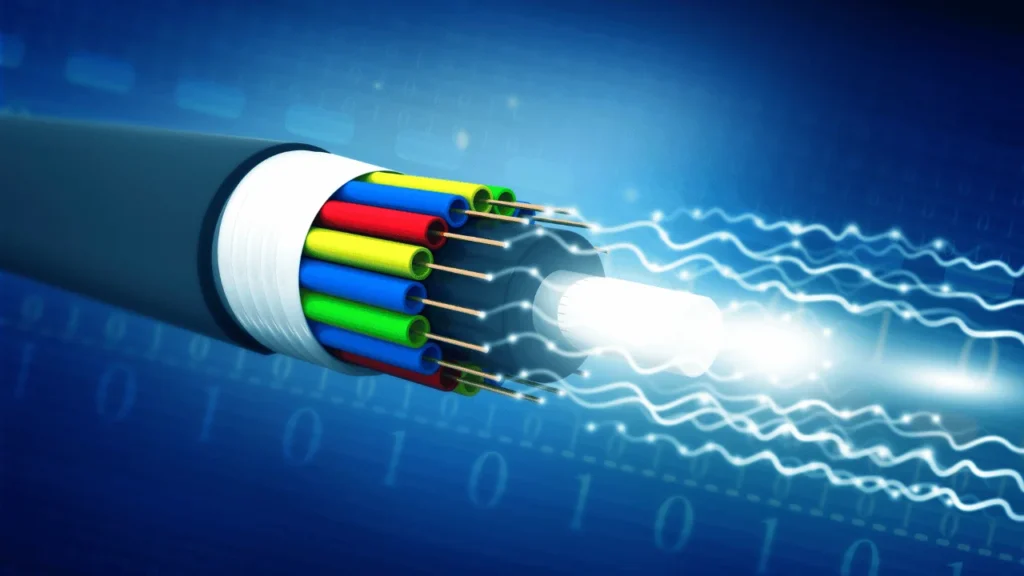
Fiber optics: What is it?
Fiber optics is a data transmission medium that uses thin strands of glass or plastic to transmit light pulses. These strands, which are thinner than a human hair, allow large amounts of information to be sent at high speeds and over long distances. Its operation is based on the principle of total internal reflection, which guides the light along the fiber without significant losses.
Who invented fiber optics?
Although the concept of transmitting light through transparent media dates back centuries, significant advances in this technology began in the 20th century. Narinder Singh Kapany, a physicist from India, is considered the “father of fiber optics.” In the mid-20th century, he conducted experiments that demonstrated the possibility of transmitting images through fiber bundles.
However, it was not until the 1970s that researchers at Corning Glass Works developed the first practical fiber optic with low signal loss, capable of transmitting information over long distances.
Fiber optics’ advantages over alternative transmission cables
Fiber optics offers numerous advantages over traditional copper cables. Some notable ones include:
- Higher bandwidth: Ideal for broadband applications and high-definition services because it allows high-speed transmission of large amounts of data.
- Lower signal attenuation: Over long distances, optical signals have less attenuation, reducing the need for repeaters and amplifiers.
- Immunity to electromagnetic noise: Electromagnetic interference does not affect optical signals, ensuring more reliable and cleaner transmission.
- Greater security: Fiber optics is a safer option for transmitting confidential data because it is more challenging to intercept than copper cables.
Fiber Optic Applications in Telecommunication
Fiber optics has revolutionized the telecommunications sector. It is used for long-distance voice, data, and video transmission, as well as in local area networks (LAN) and metropolitan area networks (MAN). Additionally, it is the underlying technology for high-speed internet, enabling access to services such as video streaming, video conferencing, and online gaming.
Fiber Optic Implementation in Telecommunications Networks
Network management systems, optical transmission devices, and cables must be installed in order to use fiber optics in telecommunications networks. This approach requires a large financial commitment as well as meticulous planning. However, because of its long-term advantages, which include more capacity, lower latency, and improved reliability, telecommunications providers believe it is a good investment.
Would you like additional information on how Optical Networks might help your company? Reach out to us.


